
The Traditional Art of Hand-Churned Deshi Bilona Ghee: Why Purity Matters
How bilona ghee is made the slow way, and three simple checks you can try in your own kitchen before you trust any jar.
Contents
Key Article Insights
- Made from curd (dahi), not from factory cream, so the flavour is deeper and nuttier.
- Pure ghee has nothing added: no palm oil, no flavouring, no colour.
- You can judge a jar by smell, melt and texture, not only by the label.
Open a jar of ghee and the first thing that tells you the truth is the smell. Real bilona ghee smells like toasted milk, a little nutty, a little sweet. A jar that smells of nothing, or of something close to perfume, deserves a second look.
This note is about how the slow method works and a few things you can check at home. None of it replaces a lab test. It only helps you notice the obvious.
1. What the bilona method really is
Bilona is the old way of making ghee. The milk is not turned into cream by a machine. It is boiled, cooled and set into curd overnight, the curd is churned, and only then is the butter heated slowly until it turns into ghee. It takes more time and gives less ghee from the same milk, which is the main reason it costs more.
Slow boiling
The milk is brought up gently over a low flame and cooled before a spoon of old curd is added to set it.
Hand churning
The curd is churned with a wooden mathani until the butter rises. Nothing is spun at high speed.
Good ghee is mostly patience. You can taste the hours that went into it.
Natural Crops Farm & Kitchen Desk
2. Bilona ghee vs. cheap blended ghee
Not every jar marked “ghee” is made the same way. The difference, in plain terms:
Cheap blended ghee
- Made from factory cream or butter oil
- Flavour and colour are often added
- Very little smell, flat taste
- Sets into a dull, pasty block
Deshi bilona ghee
- Made from curd, churned and heated slowly
- Nothing added, nothing taken out
- Warm, nutty, toasted-milk smell
- Grainy, golden and soft at room temperature
Semolina (Suji)
Fine semolina for halwa, upma, sweets and crisp snacks.
3. Three checks you can do in your kitchen
Adulterated ghee often gives itself away in small ways. Try these with a fresh spoonful:
Palm melt test
Put half a teaspoon on your warm palm. Pure ghee starts to melt almost at once and leaves the skin only lightly oily.
Heat spoon test
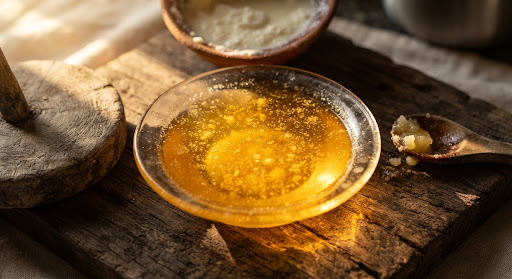
Warm a spoonful over a low flame. Pure ghee turns into a clear golden liquid and smells nutty. Cheap blends take longer or look cloudy.
Fridge test
Leave a small bowl in the fridge for an hour. Real ghee sets evenly with a grainy texture. Layers or an oily top are a warning sign.
These are folk checks, not proof. Failing one does not prove anything. If a jar fails two, we would put it back on the shelf.
4. How to keep it fresh
- Keep the lid closed and the jar away from the stove and direct sun.
- Use a clean, dry spoon every time. Water is what spoils ghee.
- A cool cupboard is enough. You do not need the fridge for everyday use.
Want to know more about the ghee we sell? Ask in the comments below and one of us will answer.
Discussion & Comments (0)
Be respectful and clearRelated Stories You Might Like
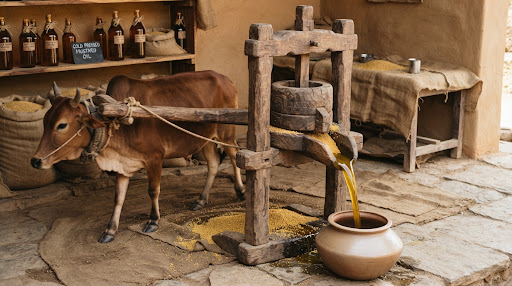
Cold-Pressed Mustard Oil: The Secret to Authentic Deshi Flavour
What gives khati sorishar tel its sharp bite, how to use it in everyday cooking and why the first heating matters.
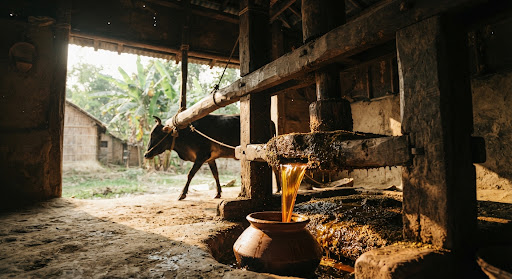
Cold Pressed Khati Mustard Oil: Why the Traditional Wooden Ghani Still Wins
A short look at how a wooden ghani presses oil, how it differs from factory refining, and how to read a bottle.

Chinigura Polao Rice Harvesting: From the Field to Your Table
Why Chinigura is harvested late, dried slowly and milled lightly, and what that does to the smell of your polao.

Leave a comment